Welcome to episode 5 of Colin’s Music Corner and the beginning of the “darker half” of the year. The light is lengthening as the angle of the sun gets lower to the horizon, and the days are rapidly getting shorter.
This month’s episode is narrated by the Corner-Keeper, and features three performances with my pal Blake Helton. We are both synthesizer and electroacoustic music enthusiasts, and this episode not only highlights some our work in the 21st century, but also points towards our love of 1970s psychedelic horror films by the likes of Lucio Fulci and Mario Bava; ’60s and ’70s English fantasy television; and synthesizer soundscapes by German pioneers like Tangerine Dream and Klause Schulze.
The ’70s were a time when the synthesizer was ascendant, and featured in many science fiction and horror films for its otherworldliness. Before the synthesizer came into its own, there were other means of electronically manipulating sound, particularly through the medium of electromagnetic tape.
French composer and musician Pierre Schaeffer had coined the term “musique concréte” in the late ’40s – music that is built up from concrete sound or recorded phenomena, as opposed to organizing sound based on pitch relations. In 1951 he gained access to a tape recorder and all of the methods one can modify sound with tape – splicing, playing backwards, playing at half speed or double speed, and looping.
His music is a precursor to ’80s sampling, which leads us to the first track, recorded in 2008.
I love the sound of distant trains, and in 2002 created a prerecorded electronic piece combining my own recordings of local Athens trains with sounds played by cellist Eunice Kang. Several years later Blake and I had acquired the equipment to actually perform with looped samples.
We utilized several short tracks or samples from a sound effects library, loaded them into our loopers and played them alongside gongs and autoharps. With a smattering of effects we created our own musique concrète piece that is strange and unsettling. I’m not exactly sure how we did it! As you listen, imagine what sort of landscape are you wandering through. It reminds me of the Tom Waits spoken word piece “What’s He Building?”
The second track is from 2022 and reminiscent of a John Carpenter film, with its incessant, doomy sequence and electronic bass drum. You can hear the rich sound of Blake’s well-loved Minimoog and my old Magnatone lap steel guitar.
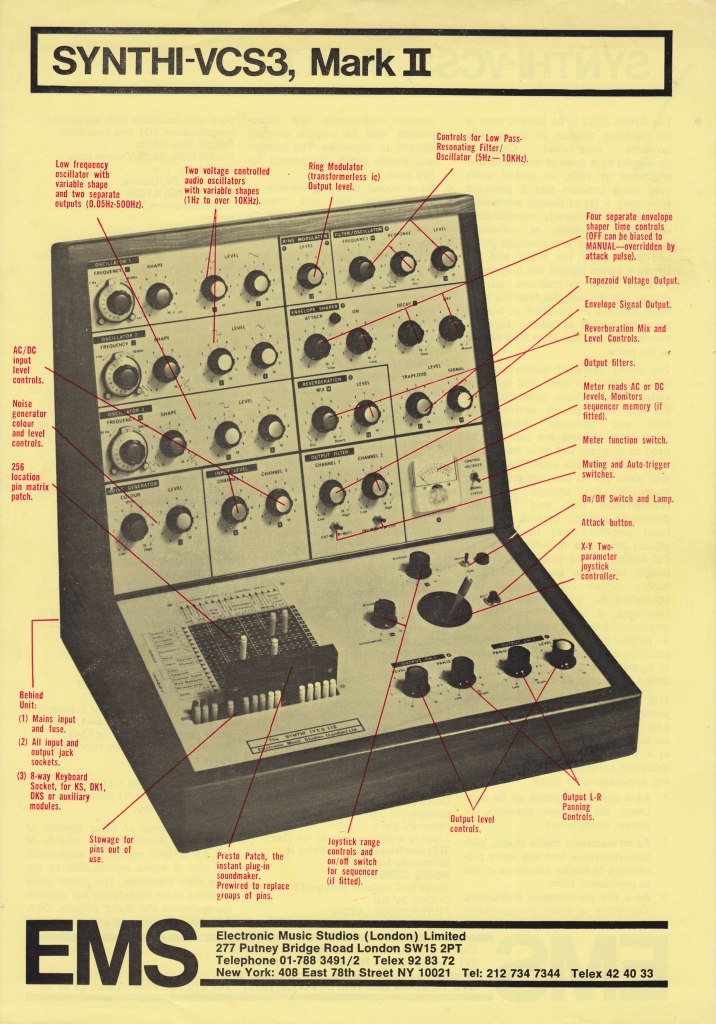
The final track is from August of this year. The main hardware instruments are modern reproductions of classic synths and keyboards, my ARP 2600m, Blake’s VCS3 clone and samples from a Mellotron loaded onto a WAV Trigger and controlled by an Arduino. The VCS3, or the Voltage Controlled Studio, was an English synth used for all sorts of media – think Dr. Who and Pink Floyd. The Mellotron is another early example of tape technology that preceded sampling. Created in 1963, it was played by pressing its keys, each of which activated a length of magnetic tape that is pulled across a playback head. The most common sounds heard from Mellotrons are those creepy string sections in Moody Blues or King Crimson tracks. Uncanny and awesome.
The track utilizes all of these sounds to create a Lovecraftian vibe – imagine an unfathomable, awesome horror from outer space, or the depths of the sea, or maybe Lake Lanier*.
Hear more Helton & Bragg, including the soundtrack for the imaginary, unrealized Italian giallo film “Natura morta con coltello” (Still Life with Knife).
*Local history note: There are claims that Lake Lanier is haunted due to the high volume of drowning deaths since the valley was flooded in 1950. The town of Oscarville was flooded for the lake, and many of the structures were not demolished beforehand, creating underwater hazards for swimmers. Oscarville had its own sad history – quickly escalating racial violence against Black inhabitants in 1912 led to their forced migration from Forsyth County and an informal ban on returning that lasted decades.
