For this episode, I want to take a moment to honor the life and work of composer Éliane Radigue (visit her bandcamp page for a solid collection of her electronic compositions on the INA grm label) who passed away earlier this year.
Her music invites a different kind of attention. Or maybe more accurately, it asks us to let go of attention as we usually think of it. Her work unfolds slowly, almost imperceptibly, favoring minuscule sonic developments stretched across long durations. This is not music that announces itself. It hums, it breathes, it shifts in ways that can feel more like the weather than a composition.
Before fully committing to this path, Radigue worked as a professional audio tape editor. That sensitivity to detail—to the smallest splice, the slightest change—wound its way into her oeuvre of sonically expansive compositions.
By around 1970, working in a shared studio with Laurie Spiegel (see Spiegel’s heartfelt post on her friendship with Élaine), she began developing her signature approach using analog systems—most notably the ARP 2500 synthesizer and magnetic tape.
Her goal was clear, even if the results felt elusive: to create a slow, purposeful unfolding of sound. Crucially, she didn’t insist that listeners meet the music halfway.
She often suggested that her pieces be played softly—that they could exist at the edge of perception, becoming part of the environment rather than the center of it.
In that way, her work reminds me of Pauline Oliveros and her philosophy of Deep Listening, a practice that expands awareness to include all sound, not just what we intend to hear. The music doesn’t demand focus, but rewards presence.
And maybe that’s her lasting gift: a reminder that transformation doesn’t have to be dramatic to be profound.
***
I had my own deep listening revelation many years ago before I learned of Radigue, Spiegel, and Oliveros.
One night, I was experimenting with abstract stream of consciousness painting, and put on the Kronos Quartet’s album of Morton Feldman’s Piano and String Quartet. It is definitely a minimalist piece — not filled with sparkling, perpetual arpeggios, but instead soft, broken chords interspersed with long silences.
Its development seemed to unfold at an almost glacial pace, which seemed to only register in a subconscious way while I worked.
I was in the zone for a long time, happily painting away. Suddenly I felt an uneasiness that I couldn’t place my finger on, like when the woods go quiet. After several moments, it dawned on me that the piece had concluded and the CD had stopped. I was alone.
From this event I realized that music can exist as an active but not overly performative presence, something that can focus one’s attention, that has enough silences within it to almost become a calm conversation partner.
***
For this episode, I want to share an homage to Éliane Radigue played on my ARP 2600, the baby version of her own massive synth. You’ll hear oscillators softly modulating one another, slowly shifting timbres, and interference patterns between two tones, or acoustic beats.
My serving suggestion is to play this fairly low, so it doesn’t drown out surrounding sounds. Play it while reading or drawing or making a meal or listening to birds, and feel what happens as it concludes. Also, don’t skip ahead! The musical changes are minimal — it’s the gradual shifts in colors and pulses that drive the piece. Similar to how the light changes at dusk.
Afterthought: After recording the podcast, I discovered this excellent article on Radigue’s drone works and how they aren’t just background sound. If you want to go back for a second serving of my performance, turn it up to Sunn O))) levels!
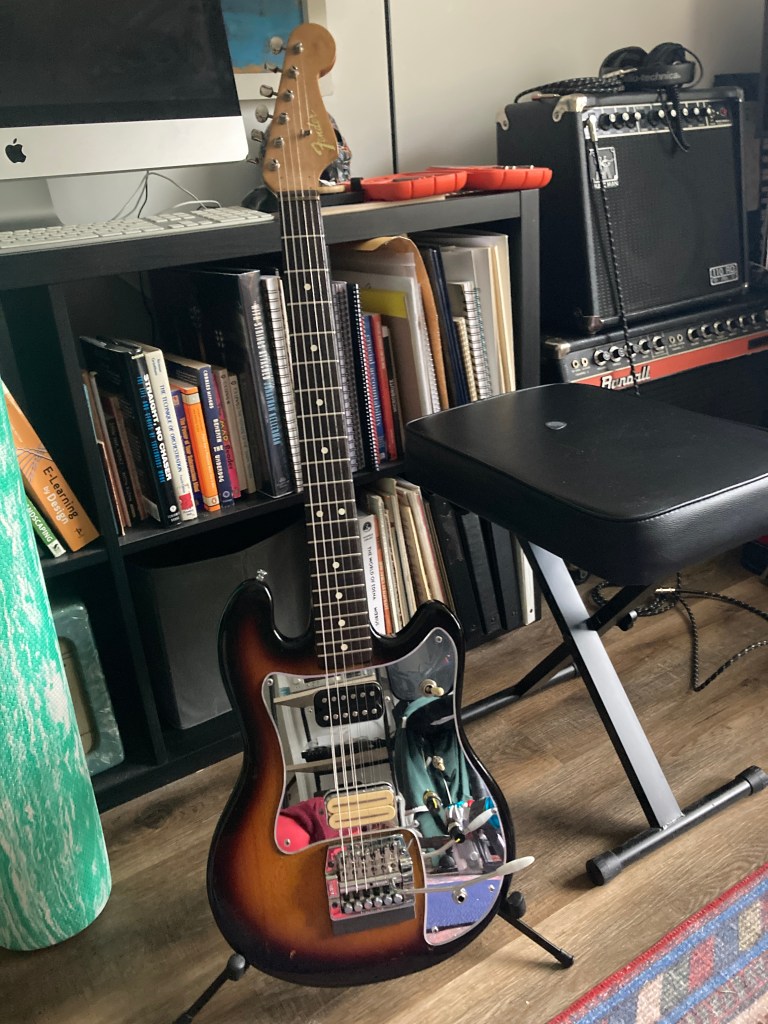
After that, I offer a second track featuring my dad’s recently reconstituted Ocelot project guitar. It started its life as a 1960s Kent Lido electric guitar (well, it was branded a “Vernon” but it’s from the same manufacturer), similar to the guitars the Velvet Underground started with. It became the basis for dad’s electronic experiments, including the addition of a serious vibrato bridge and a variety of sound-modifying switches that would have made Frank Zappa or Jerry Garcia proud.
The guitar’s electronics fell apart on me after recording my Entropy album, so I disassembled it and added various parts to other guitars. After a couple of years, I realized that I missed it, maybe the instrument that most represents dad and his always tinkering, creative mind. So, I put it back together and added my own updates. Now it’s our shared guitar project. It lends itself to lyrical playing, as heard in this track. Also, check out the strings pinging as they slide across the nut at the headstock in the end. I discovered that this creates a nice woodland texture. I hope you enjoy it.
***
I’ve discovered that I want to deepen this work, and would love your insights on the podcast and how building upon the podcast might unfold. It can go anywhere, from unique “happenings” to a low-cost subscription service or anywhere between.
If you are so inclined, take a few moments to share your thoughts via this short questionnaire. It would be great to hear from you! I look forward to building upon the success of this podcast.
